Chicago Renters: Your Landlord May Have Fixed Your Rent. Here's What You're Owed.

1. What happened
Between 2018 and 2025, some of the largest apartment landlords in the country (including several headquartered right here in Chicago) used a software system called RealPage to coordinate their rental pricing. Instead of competing with each other on rent, they fed their private, non-public lease data into a shared algorithm. The algorithm pooled all of it: actual rents being charged, vacancy rates, move-in and move-out dates, lease terms. It then spat out daily pricing recommendations. Landlords followed those recommendations 80 to 90 percent of the time.
That is price-fixing. It is illegal under federal antitrust law. And Chicago renters were at the center of it.
Two of the companies named in the DOJ's lawsuit are headquartered here: LivCor, a Blackstone company at 233 South Wacker Drive, and Equity Residential, one of the nation's largest publicly traded apartment REITs, at 2 North Riverside Plaza. Cushman & Wakefield, whose residential property management arm operated for years as Pinnacle Property Management, is also based in Chicago at 225 West Wacker Drive.
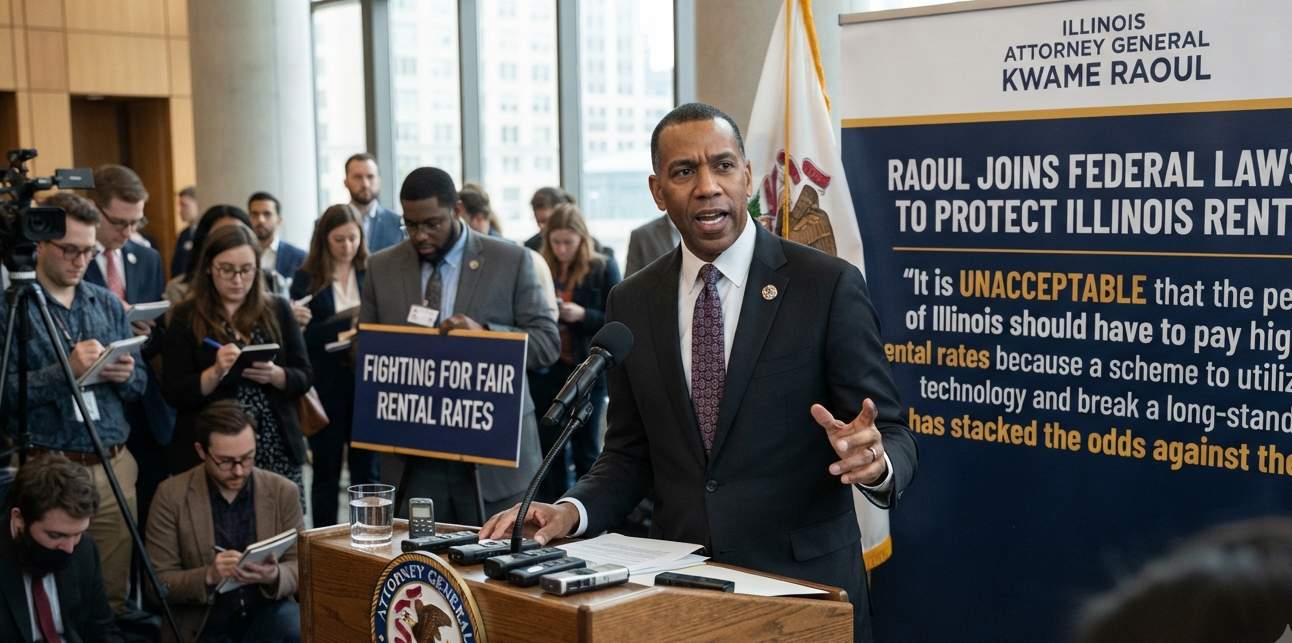
Illinois Attorney General Kwame Raoul joined the federal lawsuit specifically to protect Illinois renters, stating that it was "unacceptable that the people of Illinois should have to pay higher rental rates because a scheme to utilize new technology and break a long-standing law has stacked the odds against them."
The result: a $359,925,000 class action settlement fund. If you rented an apartment in Chicago or anywhere in Illinois from one of these companies between October 2018 and November 2025, you may be owed money. But you have to file a claim. It is not automatic.
2. The companies that operated in Chicago
These are the defendants with a known operational presence in the Chicago area, either headquartered here, managing properties here, or both.
Headquartered in Chicago
LivCor, LLC (a Blackstone company)
233 South Wacker Drive, Suite 4700, Chicago, IL 60606LivCor managed over 150,000 apartment units across 400+ properties nationwide, with its base of operations in Chicago. Named as a defendant in the DOJ lawsuit. Not yet in the civil class action settlement; the litigation against LivCor continues. If you rented a LivCor-managed property, check the property list and file a claim anyway.
Equity Residential (EQR)
Two North Riverside Plaza, Suite 400, Chicago, IL 60606 · (312) 474-1300One of the largest apartment REITs in the country, founded in Chicago by Sam Zell. Settled the class action lawsuit for $56 million. Properties primarily in urban coastal markets, but its corporate home base is here in Chicago.
Cushman & Wakefield / Pinnacle Property Management Services
225 West Wacker Drive, Chicago, IL 60606Cushman acquired Pinnacle in 2020. Both names appear in the litigation. Cushman is named in the DOJ lawsuit. Pinnacle is a named settling defendant in the civil class action. If your building was managed by either company, you may qualify.
Operating in Chicago and the surrounding area
These companies are not headquartered in Chicago but managed apartment properties in the Chicago metro area during the class period.
Greystar Management Services, LLC
Headquartered in Charleston, SC — properties in Lincoln Park, River North, Old Town, and the North Shore suburbsLargest apartment manager in the country. Settled the civil class action for $50 million, the single largest individual settlement in this case. Named in the DOJ lawsuit. If you lived in a Greystar-branded building in Chicago, you very likely qualify.
Willow Bridge Property Company, LLC
Headquartered in Dallas, TX (formerly Lincoln Residential / Lincoln Property Co.)Named in the DOJ lawsuit. Manages apartment communities in the Chicago area under the Willow Bridge brand. Previously operated as Lincoln Residential before rebranding in 2023 following acquisition by Cadillac Fairview. Lincoln Property Co. is also a separately named settling defendant in the civil class action.
Lincoln Property Co.
Named separately from Willow Bridge in the civil settlement. If your lease or rent payments were made to Lincoln Property Co. before the Willow Bridge spinoff, that entity is covered.
Brookfield Properties Multifamily LLC
Manages high-rise and mid-rise apartment communities in downtown Chicago. Named settling defendant in the civil class action.
The Related Companies, L.P. / Related Management Co., L.P.
Manages luxury and affordable apartment properties in Chicago. Named settling defendant in the civil class action.
Cortland Management, LLC
Headquartered in Atlanta, GAOperates in Chicago and several Illinois markets. Settled separately with the DOJ in January 2025, agreeing to stop using shared algorithms and competitively sensitive competitor data to set rents. Also a settling defendant in the civil class action.
Camden Property Trust
Headquartered in Houston, TXNamed in both the DOJ lawsuit and the civil class action settlement. Settled the civil case for $53 million. Operates in select Illinois markets.
Mid-America Apartment Communities (MAA) / Mid-America Apartments L.P.
Headquartered in Memphis, TNSettled the civil case for $53 million. Operates in Illinois markets.
RPM Living, LLC
Manages properties in the Chicago area. Named settling defendant in the civil class action.
Avenue5 Residential, LLC
Manages properties in Illinois. Named settling defendant in the civil class action.
Bell Partners, Inc.
Manages apartment communities in Illinois. Named settling defendant in the civil class action.
BH Management Services, LLC
Based in Des Moines, IAManages properties in Illinois markets. Named settling defendant.
Bozzuto Management Co.
Headquartered in Greenbelt, MDManages properties in Illinois. Named settling defendant in the civil class action.
FPI Management, Inc.
Manages properties in Illinois. Named settling defendant.
Highmark Residential, LLC
Manages properties in the Midwest including Illinois. Named settling defendant.
WinnCompanies, LLC / WinnResidential Manager Corp.
Manages affordable and market-rate housing in Illinois. Named settling defendant.
3. How to know if you qualify
You qualify if all three of the following are true:
- You paid rent on a multifamily apartment, not a single-family house, anywhere in the United States, including Chicago and Illinois.
- The property was owned or managed by one of the companies listed above, or a related entity, subsidiary, or affiliate.
- At least one month of your tenancy fell between October 18, 2018 and November 21, 2025.
You do not need to prove that your rent was inflated. You do not need to calculate an overcharge. You just need to show you paid rent at an eligible property during the class period.
If you are not sure whether your specific building is covered, the official settlement website has a property lookup tool. Even if your address does not appear in the database, you can still submit a claim for consideration. The absence of a property from the list does not automatically disqualify you.
Check your property now
Use the official property lookup tool to see if your address is in the settlement database.
Go to realpagerentalsettlement.com4. Step-by-step: how to file your claim
The deadline is January 29, 2027. Claims are not automatic. You must file.
Step 1 — Check your property
Go to realpagerentalsettlement.com and click "Property List" in the navigation menu. Type in the address of every apartment you rented between October 2018 and November 2025. The tool will tell you whether that address is in the settlement database.
If your address comes up: proceed to Step 2. If it does not come up: still proceed to Step 2. You can still file a claim; the settlement administrator will review it.
Step 2 — Gather what you have
You will need:
- The street address of each property you rented during the class period
- The approximate dates of your tenancy (month and year you moved in, month and year you moved out, or through November 2025 if you were still there)
- Your approximate monthly rent for each property
- Documentation showing you personally paid rent there
Acceptable documentation includes a lease agreement, rent receipts, bank statements or canceled checks showing rent payments, money order receipts, or any written record connecting you to the property and the payment. You do not need a perfect set of documents. Even one month's bank statement showing a rent payment works as a starting point.
If your name changed since you rented (due to marriage, divorce, or a court order), also gather documentation connecting your old name to your current name. A marriage certificate, divorce decree, or updated government-issued ID all work.
Step 3 — File online (easiest)
Go to realpagerentalsettlement.com and click "Submit a Claim." Fill in:
- Your full legal name and current contact information
- Each rental property address, with the dates you lived there and your monthly rent amount
- Upload your documentation (photos of documents are fine)
- Select your preferred payment method: PayPal, Venmo, Zelle, virtual prepaid card, or paper check by mail
Save your claim confirmation number when you finish.
Step 4 — Or file by mail
If you prefer paper, download the claim form PDF from realpagerentalsettlement.com, print it, fill it out by hand, and mail it with your documentation to:
RealPage Rental Software Litigation
Settlement Administrator
Attn: Claim Form
(Full mailing address is on the claim form and on the settlement website)
Mail it early enough to be received, not just postmarked, by January 29, 2027.
Step 5 — Wait
After you file, the settlement administrator will process your claim. If they need more documentation, they will contact you. No payment will be issued until after the court grants final approval at the fairness hearing scheduled for October 15, 2026.
Once final approval is granted, payments will be distributed on a pro-rata basis based on how much rent you paid during the class period. The more rent you paid, the larger your share of the fund.
5. Key dates at a glance
| Date | What it means |
|---|---|
| September 1, 2026 | Deadline to opt out of the settlement (if you want to sue separately) |
| September 1, 2026 | Deadline to object to the settlement terms |
| October 15, 2026 | Court fairness hearing (attendance is optional) |
| January 29, 2027 | Deadline to file your claim — the most important date |
6. What you do NOT need to do
- You do not need to hire a lawyer. Filing is free directly at the settlement website.
- You do not need proof that your rent was specifically inflated.
- You do not need to calculate a damages amount.
- You do not need to have received a notice in the mail. Many people were never notified and still qualify.
- You do not need to pay any third party to file on your behalf. Anyone charging you to file a claim on this settlement is a scam. The official site is always free.
7. What happens if you do nothing
If you do not file a claim, you receive no payment. You will also be bound by the settlement, meaning you give up your right to sue the settling companies over these specific rent-fixing allegations. Filing is the only way to receive money.
8. The bigger picture
The settlement carries no admission of wrongdoing by any of these companies. The DOJ's separate settlement with RealPage also imposed no financial penalty and no admission of liability, just restrictions on future data practices. Four state attorneys general formally objected that those terms did not go far enough.
For Chicago renters, the local stakes are high. Multiple companies at the center of this case are based here. Equity Residential's corporate headquarters sits in the Loop. LivCor, a Blackstone operation headquartered on Wacker Drive, manages a vast national portfolio using Chicago as its base. The Illinois AG is an active plaintiff in the federal enforcement case. State-level litigation continues and may produce additional remedies down the road.
But none of that puts money in your pocket automatically. Filing a claim does.
9. Contact and resources
Case: In re RealPage, Inc., Rental Software Antitrust Litigation (No. II) · Case No. 3:23-md-03071 · U.S. District Court for the Middle District of Tennessee, Nashville Division
Related articles
FAQ
Who qualifies for the RealPage settlement in Chicago?
You qualify if you paid rent on a multifamily apartment anywhere in the United States, the property was owned or managed by one of the named settling defendants or a related entity, and at least one month of your tenancy fell between October 18, 2018 and November 21, 2025. You do not need to prove your rent was inflated.
Which Chicago landlords are named in the RealPage lawsuit?
Several companies headquartered in Chicago are named. LivCor (233 South Wacker Drive) and Cushman & Wakefield / Pinnacle Property Management (225 West Wacker Drive) are named in the DOJ lawsuit. Equity Residential (Two North Riverside Plaza) settled the civil class action for $56 million. Other companies operating in the Chicago area that are named defendants include Greystar, Willow Bridge, Cortland, Brookfield Properties Multifamily, Lincoln Property Co., The Related Companies, and WinnCompanies, among others.
How do I file a RealPage settlement claim in Illinois?
Go to realpagerentalsettlement.com, use the property lookup tool to check your address, and click Submit a Claim. You will need your rental address, lease dates, approximate monthly rent, and documentation showing you paid rent there, such as a bank statement or lease. The deadline to file is January 29, 2027. Filing is always free.
What is the deadline to file a RealPage settlement claim?
The deadline to file a claim is January 29, 2027. Claims are not automatic. If you do not file, you receive no payment and give up your right to sue the settling defendants separately.
How much money will I get from the RealPage settlement?
Individual payment amounts have not been announced. Payments will be distributed on a pro-rata basis from a total fund of $359,925,000, based on how much rent you paid at an eligible property during the class period. The more rent you paid, the larger your share.