Illinois Safe Homes Act: Your Housing Rights as a Survivor
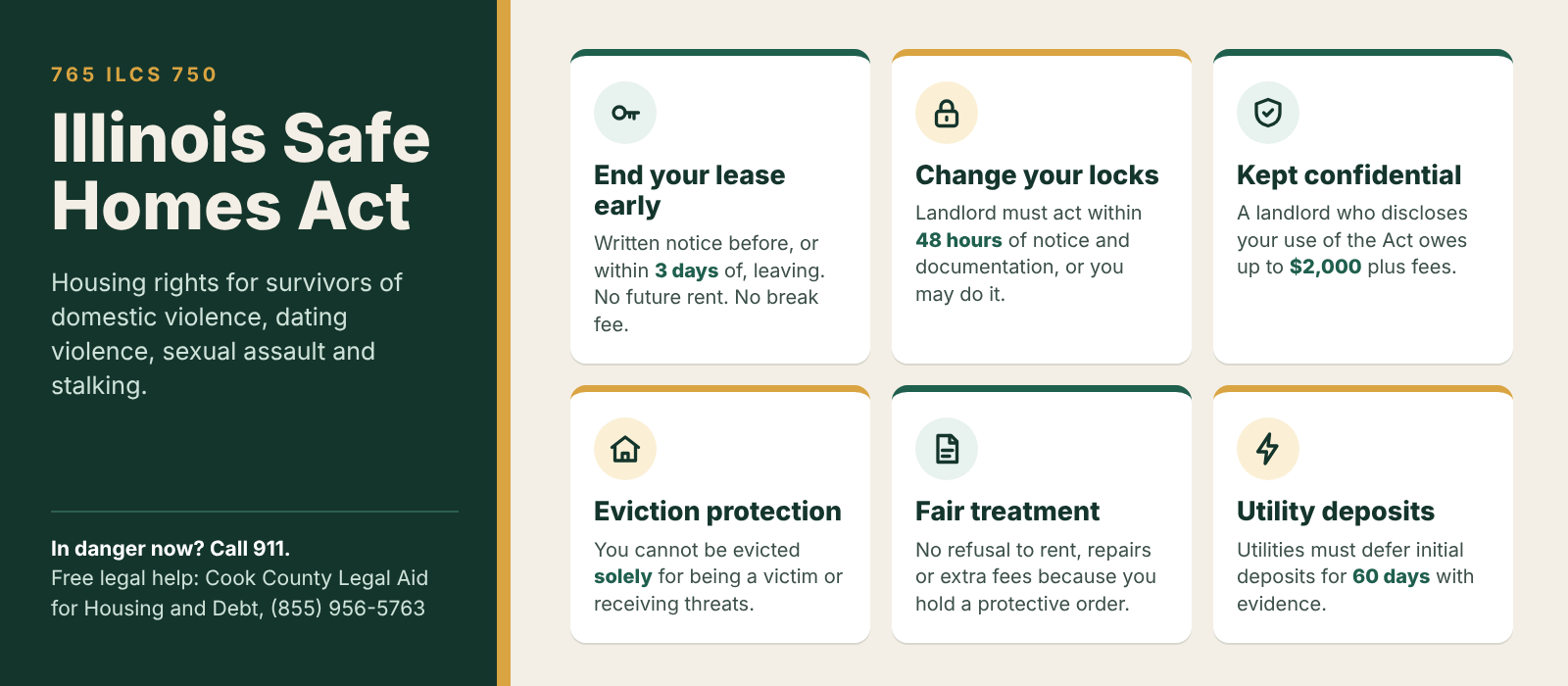
At a glance
- If you or someone in your household is a survivor of domestic violence, dating violence, sexual assault or stalking, Illinois law gives you special housing rights.
- You can end your lease early without owing future rent or an early termination fee, if you give written notice before, or within three days of, permanently leaving.
- You can change your locks. The landlord must change them or let you do it within 48 hours of your written notice and documentation.
- You cannot be evicted solely because you or a household member is a victim, and your landlord cannot share that you used the Act.
- Since January 1, 2026, every Illinois residential lease and renewal must start with the official Summary of Rights for Safer Homes.
1. Who the Act protects
The Illinois Safe Homes Act (765 ILCS 750) gives housing protections to tenants who are, or whose household members are, survivors of domestic violence, dating violence, sexual assault or stalking. The protections reach beyond ending a lease. They cover changing locks, confidentiality, defenses to eviction, discrimination, local "crime-free" penalty ordinances and utility deposits. The protections apply to Illinois tenants generally, not only to Chicago, so they work alongside the Chicago RLTO.
Each right comes with its own notice and documentation requirements, and they differ from one right to another. The sections below spell out each.
2. The summary at the front of your lease
Landlords must give tenants the Summary of Rights for Safer Homes as the first page of every written Illinois residential lease, whether the lease is new or a renewal. It applies to leases and renewals signed on or after January 1, 2026. The official version, published by the Illinois Department of Human Rights, has to be used unabridged. A paraphrase does not satisfy the requirement.
When you sign a lease or renewal, check for these:
- The summary is the first pages of the lease, not buried at the back.
- It is the full official text, not a shortened version.
- Each page has a place for your signature, and you sign each page to acknowledge receipt.
- You and the landlord each keep a signed copy.
If your lease does not include it, ask the landlord for it in writing and keep the request. What a missing summary means for your rights is something to ask a legal aid organization about. The Act's rights do not depend on whether the landlord handed you the document.
For other lease items worth checking at the same time, see our lease red flags guide.
3. Free tool: Safe Homes Notice Builder
No signup. Runs in your browser and nothing is sent anywhere. Pick what you want to do, enter your dates, and the tool checks the timing in the official summary and drafts a written notice you can edit. You do not enter anyone else's name, and you do not have to describe what happened.
Downloaded files stay on the device you use. If someone else can see that device, consider whether to download, and delete the file and your browser history afterward.
4. Ending your lease early
Under the Act, you can end your lease early and not pay future rent when you move out because of a threat of domestic violence or sexual violence. The official summary describes the process this way:
| What | What the summary says |
|---|---|
| Notice | You must give your landlord written notice that you are leaving, before or within three days of permanently leaving. Examples of permanently leaving include removing all your belongings and turning over your keys to the landlord or property manager. |
| Grounds | You have left, or are leaving, because you are under an imminent threat of domestic violence or sexual violence at the rental place. |
| Sexual violence at the rental | You can also end the lease by written notice and documentation if sexual violence occurred at the rental within the last 60 days, or later if circumstances prevented you from telling the landlord sooner. |
| Rent | You owe rent for the period before you gave notice and permanently left. You do not owe future rent after that and cannot be charged an "early lease break fee." |
| Deposit | Your landlord should return your security deposit if there is no previous unpaid rent or damage beyond normal wear and tear. |
Practical points
- Make the notice written and dated. Email, certified mail or a hand-delivered copy with a signed acknowledgment all create proof. Keep a copy.
- Keep the notice short. It needs to say you are ending the lease under the Act and when you are leaving. It does not need a detailed account of what happened.
- Attach or offer the documentation the Act asks for and send copies, not originals.
- Give a safe mailing address for your deposit and any notices.
- Document the unit when you leave. Photos and a walkthrough protect your deposit. See our move-out documentation guide and deposit law guide.
- If the landlord keeps your deposit or charges a fee, that is worth raising with legal aid. See what to do if your deposit is not returned.
5. Changing your locks
You have the right to change your locks to prevent further domestic violence or sexual violence at your rental. To use it, the summary says you must give your landlord written notice that you are under an imminent threat of domestic or sexual violence, along with one of these:
- medical, court or police evidence, or
- a statement from an employee of a domestic violence or other victim services organization from whom you or a household member sought services.
The landlord then must change the locks, or give you permission to change them, within 48 hours of your notice and documentation, at your reasonable expense. If the landlord does not act within 48 hours, you can change the locks yourself and give the landlord the new key within 48 hours.
If the person who may harm you is also a tenant on your lease, the documentation is different. You must give the landlord a plenary order of protection or a plenary civil no contact order that gives you exclusive possession of the residence. The other kinds of documentation do not substitute in that situation.
6. Confidentiality
A landlord who tells a prospective landlord that you used the Safe Homes Act, or who shares information you provided when using it, can be liable to you for actual damages up to $2,000 and reasonable attorney's fees. If you suspect it happened, write down who, when and how you found out, and ask a legal aid organization about your options.
7. Eviction protections
If your landlord tries to evict you because you or a household member experienced domestic violence, dating violence, sexual assault or stalking, you may be able to stop the eviction. The summary says you cannot be evicted solely because:
- you or a household member is a victim of an actual incident of domestic violence, dating violence, sexual assault or stalking;
- you or a household member received threats of that kind of violence;
- there was criminal activity in the form of domestic violence, dating violence, sexual violence or stalking against you or a household member; or
- you did not knowingly consent to a person entering your rental that the landlord had barred, or the barred person is permitted by court order to enter.
When you raise any of these as a defense, you must provide at least one form of evidence of your status, such as medical, court or police records or a statement from a victim services organization. A landlord may still be able to evict you if they prove your continued presence poses an actual and imminent threat to others at the rental. Because eviction deadlines move quickly, get legal help immediately. Our eviction process guide explains the court steps, and if the eviction followed a complaint or request you made, our retaliation guide may help too.
8. Protection from discrimination
Under the Illinois Human Rights Act, a landlord cannot discriminate against you because you have an order of protection, a stalking no contact order or a civil no contact order. A housing provider cannot refuse to rent to you, refuse to make repairs or charge you additional fees for that reason. Possible remedies include actual damages and attorney's fees. You can file a housing discrimination charge with the Illinois Department of Human Rights within one year of the discrimination, or file in circuit court within two years.
9. Crime-free and nuisance ordinances
Illinois prohibits counties and municipalities from creating or enforcing laws that penalize tenants who are survivors of domestic or sexual violence when they, or their landlord, contact police or emergency services. According to the summary, you cannot be penalized for:
- calling police or emergency services to prevent or respond to domestic or sexual violence;
- incidents of domestic or sexual violence against you, a household member or a guest; or
- criminal activity related to domestic or sexual violence at your rental.
If you are penalized, the summary says you may file a complaint in circuit court under Section 1-2-1.5 of the Illinois Municipal Code and Section 5-1005.10 of the Illinois Counties Code. Calling for help should never be the reason you lose your home. If a landlord threatens you with a "three strikes" or nuisance policy because of calls for help, save the message and talk to legal aid.
10. Utility deposits
Utility companies must defer initial credit and deposit requirements for 60 days for a residential customer or applicant who is a victim of domestic violence (220 ILCS 5/8-201.6). You provide evidence such as an order of protection, a certifying letter from a medical provider or shelter, or law enforcement documentation. If you are setting up service at a new home, ask the utility about this before you pay a deposit.
11. If you have a federal subsidy
If you apply for or live in federally subsidized housing, you have additional protections under the federal Violence Against Women Act (VAWA) for domestic violence, sexual assault, dating violence and stalking. If you receive a voucher or live in subsidized housing, tell a legal aid organization early, since your housing program's own rules may apply.
12. Keeping records safely
- Keep copies somewhere the other person cannot get to: a trusted friend, an advocate, a new email account only you access, or a secure folder.
- Date everything. Notices, delivery receipts, photos, and the names of anyone you spoke with at the landlord's office.
- Ask your advocate. A victim services organization can write the statement the Act accepts as documentation and can help you plan around your safety.
- Think about shared devices and accounts. A shared phone plan, cloud account or browser history can reveal what you searched or saved.
- Send your notice in a way you can prove. Certified mail with return receipt or a dated email with a read receipt, whichever is safe.
13. Free legal help
The official summary lists these free legal service providers. Confirm current contact details on each organization's website.
- Ascend Justice: free legal representation for survivors who need to break a lease or change locks, at ascendjustice.org/finances-housing.
- CARPLS: legal hotline for Cook County residents, (312) 738-9200.
- Cook County Legal Aid for Housing and Debt Hotline: (855) 956-5763.
- Eviction Help Illinois: evictionhelpillinois.org.
- Illinois Legal Aid Online: illinoislegalaid.org, with the Safe Homes Act at ilao.info/dvleases.
- Land of Lincoln Legal Aid: lincolnlegal.org/apply-for-legal-services, eviction hotline (855) 601-9474.
- Legal Aid Chicago: legalaidchicago.org/get-help, fair housing intake line (312) 423-5909.
- Life Span: life-span.org/get-help, (312) 408-1210.
- North Suburban Legal Aid Clinic: nslegalaid.org/get-help/housing.
- Prairie State Legal Services: pslegal.org/How-To-Get-Started, domestic violence line (844) 388-7757.
14. Related articles
15. FAQ
Can I break my lease in Illinois if I am a victim of domestic violence?
The Safe Homes Act lets you end your lease early and not pay future rent if you leave because of a threat of domestic or sexual violence, as long as you give your landlord written notice before or within three days of permanently leaving. You owe rent only for the period before you gave notice and left.
Can my landlord charge me a fee for leaving early under the Act?
No. According to the official summary, you cannot be charged an early lease break fee.
Can my landlord refuse to let me change my locks?
The landlord must change the locks or give you permission within 48 hours of your written notice and documentation. If they do not, you can change them and give the landlord the new key within 48 hours.
What documentation do I need?
For changing locks, medical, court or police evidence, or a statement from an employee of a victim services organization. If the person who may harm you is also on your lease, a plenary order of protection or plenary civil no contact order giving you exclusive possession is required instead.
Can I be evicted because I am a victim?
You cannot be evicted solely because you or a household member is a victim of domestic violence, dating violence, sexual assault or stalking, or because of threats or criminal activity directed at you. You must provide evidence when raising the defense, and a landlord may still evict if they prove an actual and imminent threat to others.
Can my landlord tell a new landlord that I used the Act?
No. A landlord who does so, or who shares information you provided, can be liable for actual damages up to $2,000 and reasonable attorney's fees.
Is the Safe Homes Act only for Chicago?
No. It is an Illinois law that applies statewide.
Does my lease have to include a summary of these rights?
Yes. For leases and renewals signed on or after January 1, 2026, the official Summary of Rights for Safer Homes must be the first pages of the lease, unabridged, and each page signed by the tenant.